Multilingual Cognition as an Asset
What the Research Says and How CLARO Responds
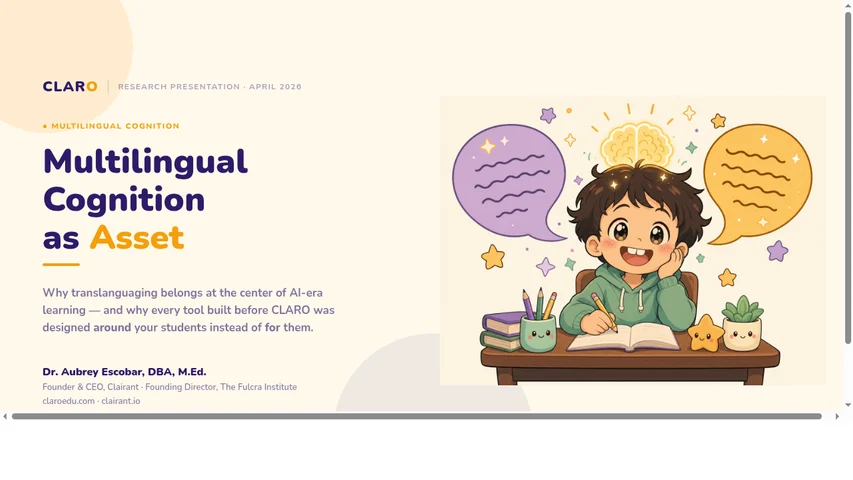
What you'll learn in this webinar
This is not a product pitch. It's a research conversation — grounded in forty years of cognitive science — about why the tools we've been using with our bilingual students have been working against the very strengths those students bring to school every day.
Why bilingual learners have documented cognitive advantages — and why the achievement gap persists anyway
How EdTech built its multilingual tools on the wrong model of the bilingual mind
What translanguaging research reveals about how the bilingual brain actually works
How CLARO is the only K-12 tool built with translanguaging as a structural feature
What "process data" means — and why it changes what districts can document and prove
Drawing on Adesope et al. (2010) meta-analysis of 63 studies, García & Wei (2014) translanguaging framework, NAEP longitudinal data, and Nystrand's (1997) classroom dialogue research — this webinar connects the science directly to what districts can do differently today.
Watch the webinar
Register once — watch instantly.
Three things this webinar will change how you think
These aren't talking points. They're structural arguments — grounded in forty years of cognitive science — about why the tools we've been using with multilingual learners have been working against the very strengths those students bring to school.
Bilingual cognition is a measurable advantage — but only if the tool is built to see it.
Adesope et al.'s meta-analysis of 63 studies found effect sizes up to g = 0.96 for attentional control in bilingual learners. The gap isn't a deficit in the student. It's a deficit in how we've been measuring and teaching them.
Translanguaging is not a workaround — it is how the bilingual brain actually works.
García & Wei (2014) established that bilingual speakers do not operate two separate language systems. They draw from one integrated repertoire. Every EdTech tool that forces language selection is working against the student's cognitive architecture.
Process data is the only data that shows reasoning in motion.
Performance data tells you what a student produced. Interaction data tells you what they clicked. Process data — the observable trace of how reasoning reorganized through dialogue — is what CLARO measures. It is the only tier of data that captures thinking, not just output.
Ready to see what this looks like in a real classroom?